
Five things I like & dislike.
Taiwan Tea Odyssey
Taiwan Tea Odyssey is the most interesting new blog that’s started in a long while and one that works well in conversation with long running blogs like Marshaln. Started in 2023, it details Alex’s excursions in the Taiwanese tea scene as well as his personal exploration into tea, primarily focused on pu’erh. Due to becoming a father in 2023 I got caught up to the blog a bit late, but it is all well worth reading. I got to meet Alex when I visited Taipei in 2024 and he’s an inquisitive person and thorough researcher. High recommendation and also a great instagram follow (@alexbtw886). A must read for anyone into pu’erh or considering visiting Taiwan.
The Return of the Blogs: Substacks
Alex’s blog is a good ol fashioned wordpress, but there’s a whole rash of blogs using the newer platform, Substack. While Discord has been a boon for tea conversation, most of the information is private and not formatted in an easily searchable way. That’s why it’s been nice to see a rebirth of tea blogs in a new form. Check out the following:
- Short Little Steeps – Seo who has become one of the most interesting new vendors, Listening to Leaves. Seo blogged on and off on blogspot before and has migrated it all to this substack.
- Wet Leaf Dry Leaf – I’ve known Hanji for about a decade and he’s one of the few veteran tea drinkers who still is super into Taiwanese oolongs. Good combination of oolong and pu’erh content.
- Chili – A very young but well traveled pu’erh fan. Interesting because Chili actually goes to the mountains and has more varied experiences than anyone his age has any business having.
- Skylarke – I’ve had tea with Skylarke a few times and she drinks from quite a few categories. The blog is still young but she has a nice write-up scoping out the Hongcha scene.
- Water Friend – A blog mostly focused on Heicha.
- Erdaifu – A blog mostly focused on another unsung category, Dancongs.
- The Path Less Taken – A blog mostly focused on Liubao.
Blogging is a practice where many fall off especially by the six month mark. Some of these will or already have but there’s still some interesting content even if it’s just a handful of posts.

Vendors Pretending That Storage Doesn’t Matter
Vendors have not really been trend setters when it comes to storage. Once they sell the tea it is the customer’s business. Sure you have the occasional weirdo vendor with strong opinions like Hojo, but it’s been more of a hobbyist lead space. I’ve seen and heard of vendors saying that we significantly overrate or fuss about storage. Yadda yadda, different expressions of the same material. I don’t agree with this attitude. Storage absolutely matters and not just when it is convenient. Unless we are talking about young pu’erh it is an important component for how a tea ends up. And depending on the tea it can absolutely make or break a tea. Pretending it does not matter is lazy.
This is also not a specific shot at something I’ve read or heard, just a response to numerous vendor murmurings throughout the years.
Accessible Dayi
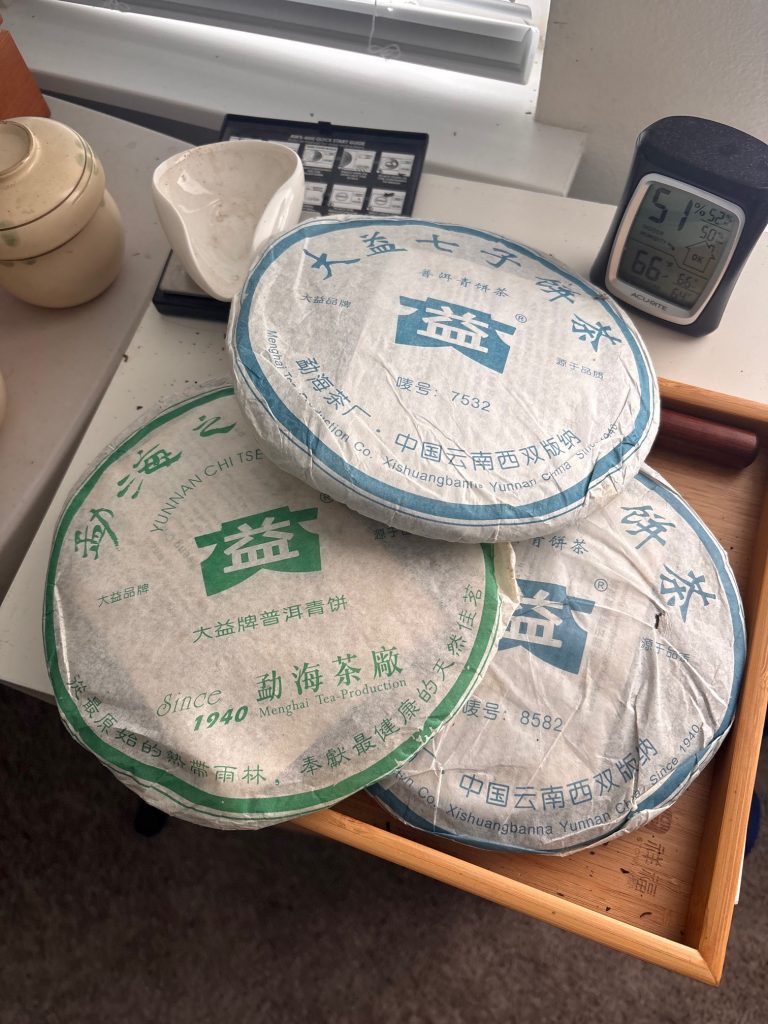
Pu’erh is a diverse tea and the culture around it is as well. You can think of pu’erh culture as a ton of different bubbles. Depending on which circle(s) you exist in, you can be exposed to vastly different thinking on the same topics and it’s important to at least understand and acknowledge the exposure of certain beliefs and opinions over others. If you have boots on the ground in Yunnan and are going up to the mountains you’ll be exposed to different opinions centered around younger pu’erh. This of course extends to brands as well. Dayi tea is not the favored brand in all pu’erh circles and it is absolutely possible to be a tea or pu’erh fan and drink minimal Dayi but it is an extremely prominent brand with a large footprint in quite a few circles.
In the west we are certainly not exempt from bubbles and bias. The western tea community’s interests shift over time but I’d argue that the west has been comparatively boutique focused when compared with the tea scene in Taiwan or Hong Kong. There’s often a rush towards the rare and perceived higher-end offerings often at the expense of skipping more meat and potato factory pu’erh. I think having a major factory like Dayi around and accessible helps to counterbalance the western scene. There’s plenty of room for both boutique and factory, and Dayi helps to represent a popular type of pu’erh. Rather than a small operation, they represent both a historic growing area (Menghai County) as well as a high-volume factory with a long history of producing both raw and ripe. I also believe Dayi makes higher-quality, more accessible tea than many factory alternatives like Xiaguan or Mengku.
The Comfortable Mafia & Full Body Reviews
I’ve seen some people say that the comfortableness of a tea is the most important factor about tea. I think this is an odd starting point. Obviously a truly uncomfortable tea is disqualifying (stomach pains, anaphylaxis, etc), but if I took pure comfort to its logical endpoint I’d end up with some odd conclusions. In the max comfort universe, my GOAT would be something like traditionally stored Yee On ripe tea, which is much more comfy and easy going than trash like the 1988 Qingbing. In the real world, does that make the Best Taste a better tea than the 88 QB? Absolutely not. As much as I enjoy my traditionally stored tea this would also be a very boring world and not one I wish to live in.
I don’t deny there can be some somatic impacts for tea and pu’erh. These can be important but they don’t appear in the vast majority of tea or pu’erh and they are very rarely the only thing worth talking about with tea. They’re also not simple to grasp in a consistent manner and I think it’s pretty obvious there’s a lot of overreach when it comes to newer drinkers putting their thoughts online. If I see a new drinker talk about minuscule body impacts that sound like a local massage place’s sales copy about releasing shoulder tension and tingling in their left ankle, I start to question what we are all really doing here.
You can talk yourself into pre-determined effects. Placebo effects are absolutely real. And if I repeatedly told myself young pu’erh from X Brand that is not well liked would hurt my stomach and kill me, my perceptions of the tea would be impacted. Or if I focus really deep down hunting for every minor quality to a tea that I know is well liked, it is given a significant advantage that is not granted towards other teas. For a veteran with years of experience I give a certain degree of trust, but I’ve seen plenty of impressionable newer drinkers jump to conclusions about what is good or bad uncomfortably quickly, based off what I suspect they think they are supposed to like or dislike.
The reality is you can setup tea for success or failure and make just about any tea uncomfortable. Leafing too hard, drinking several teas beforehand, drinking on an empty stomach, etc. If you really want to get something out of a sample it’s important to at least give tea a reasonable shot at success. Otherwise, why bother? The same way you can setup a tea for failure and stomach discomfort you can make plenty of mediocre or low quality teas reasonably comfortable. In the end, I think some people are too aggressive in attributing certain things to the tea especially on a granular steep by steep level of detail. It is reasonable to say a tea is energizing or even upwards or downwards.


Leave a Reply