
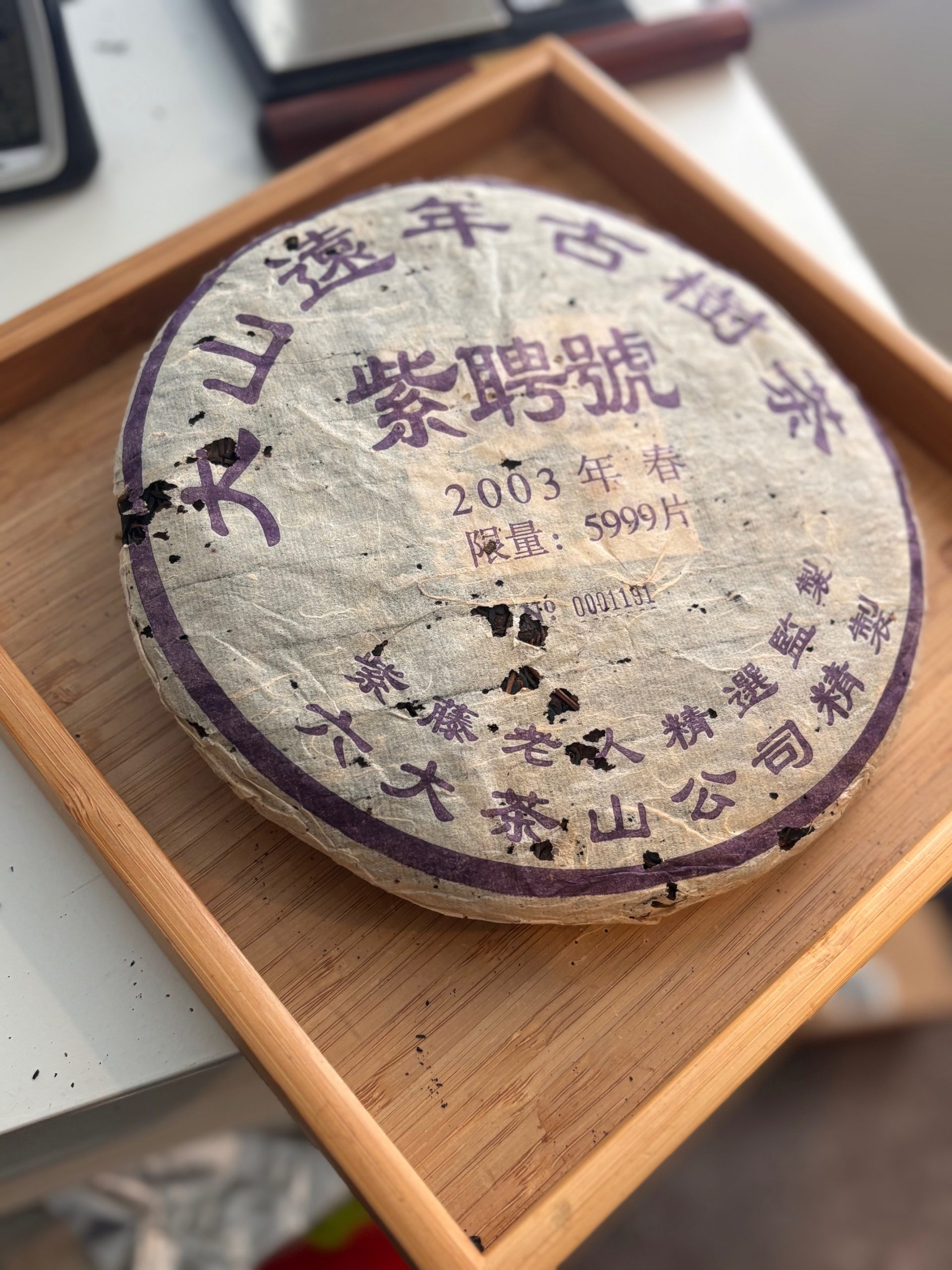
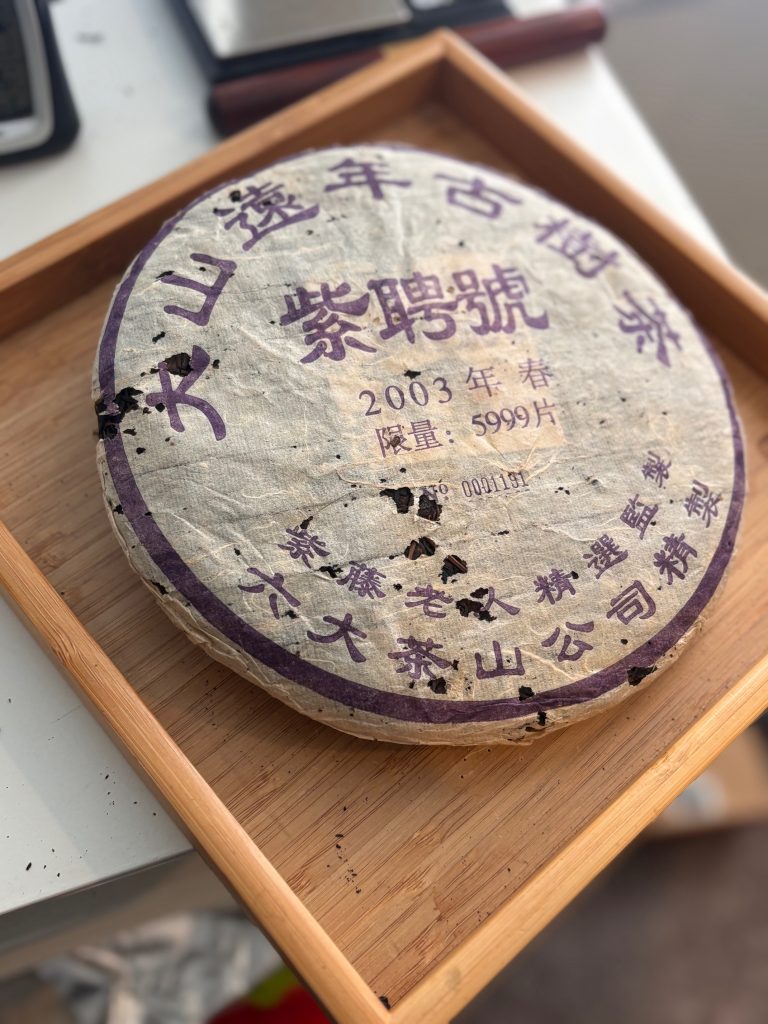
Thanks to Listening to Leaves I recently got to try a few versions of the famous Wistaria Zipin cake. The Zipin is a 2003 Yiwu pressed by Wistaria via the Six Famous Tea Mountains company. In the west it is probably the most famous Wistaria pressing. I think because I contributed a portion of my 2005 cake I was sent a set of these. Regardless, it’s a pretty interesting set of teas and storage. One of the best things about Listening to Leaves is the effort to create educational experiences through tasting sets. It creates common teas that share storage that can be discussed. It’s not possible to account for all the variables that go into making a cup of tea what it is (i.e. water, body) but it accounts for a lot of them. It’s also an interesting exercise to separate the storage from the material. In Wistaria’s case the tea all comes from their storage just at different points of time, a storage that is noted for a particular perfumey note. Because these have been stored differently they are an important datapoint in understanding both storage and the material.
The seven versions:
- Tuo
- Loose
- 2005 Zipin (my storage for 2-3 years)
- Malaysia
- Singapore
- US (Seo’s)
- Direct from Paris
This comparison had obvious goals. Main aspects being examined:
- Storage
- Compression
Because the samples were 6 grams and a primary purpose was examining the storage, I brewed them in a slightly atypical manner at 3 grams with longer steeps. I also did not break them up fully before blinding so it made the tuo and loose fairly obvious. I did not reveal these until I finished the whole exercise.
The Teas
Tea #1:
Thick, wood, pine. Mouthcool. Great aftertaste but otherwise does not have the Wistaria perfumed aroma. The tea is not as far along as my recent experiences with the Zipin. I actually don’t mind the storage that much here, despite my general preference for darker more further along teas. It’s clean, unobtrusive and lets the tea do the talking. I do think the time in Wistaria first probably did a lot of heavy lifting, by getting this to a more aged place.
Guess: US.
Answer: US.
Tea #2:
Spiced, leather, deep, darker, wood, richer. Easily the furthest along. I think there’s some hints of the Wistaria storage taste but it is covered up. My favorite of the batch. This very clearly resembles Malaysian storage I’ve had. Given Singapore is a very similar location that is also possible.
Guess: Malaysia.
Answer: Malaysia.
Tea #3:
Brighter, almost some dry flowers potpourri, but still some wood, plum, a bit medicinal base. Like tea #1 does not resemble Wistaria, so I’m guessing this was bought earlier. This tea gradually picks up greener notes as it brews out more than the others. It may’ve been bought the earliest? By process of elimination I am placing this as Singapore. The tea is further along than #1, but not nearly as far along as #2. I’d guess that the environment this is stored is somewhat cooler than tea #2.
Guess: Singapore.
Answer: Singapore.
Tea #4:
Picking at this it was clearly the tuo. This is nice. Plum, wood, juicy. Definitely still has some Wistaria house perfume taste on it still. Nice and rich. If not for the compression I think this is close enough to be mistaken for the cake.
Guess: Tuo.
Answer: Tuo.
Tea #5:
Finally a minor dud. This feels shallower and lacks the richness of the others. The taste is similar but it lacks the vibrancy of the previous four teas. The aftertaste is there and as it brews out you can tell it is the same tea. It has some of the Wistaria house perfume note. My guess was the 2005, because it is a weaker version in my experience.
Guess: 2005 Wistaria.
Answer: Direct.
Tea #6:
I did tea #6 and #7 on a different day than the first five. This is pretty straight down the middle. Rich, concentrated, sugarcane. Good aftertaste. Definitely a fair bit of Wistaria house taste.
Guess: Direct.
Answer: 2005 Wistaria.
Tea #7:
Clearly the loose. The most divergent. The structure of the tea just completely unravels and makes something close to unrecognizable. It lacks the body and density that all the other teas had. Kind of a vague sweetness that doesn’t have the deeper woody notes that the others have. The aftertaste still bears some resemblance but this behaves like a very different tea than the rest.
Guess: Loose.
Answer: Loose.
Rankings of the 2003
MY >> SG > US >>> Paris
Given my preferences it is unsurprising that I rank Malaysia the highest. It hits a lot of my own preferences and produces the richest, deepest, most satisfying brew. Malaysia vs. Singapore is also interesting. I suspect this is simply the case of how they were stored, with the Malaysian storage presumably being a bit hotter. Over a significant period of time a 5F difference could have a rather large impact on the final product. It is also promising that both SG and US stored teas lost that Wistaria note. I presume they all had at least a decade in Wistaria’s own storage, so losing it is notable especially in the case of the US stored tea. The US stored tea from Seo’s storage was better than I anticipated. While it hadn’t aged to the extent of the Malaysian tea it’s at a place where I would not mind drinking it at all and the tea’s natural quality shines bright.
Wistaria Paris Zipin & The Importance of Conditioning
And finally the case of Paris. I had forgotten that direct was from Paris and not Taipei when I did this. The tea felt dried out and ironically I thought it might’ve been my contribution. I suspect that this is a tea that’s been in Paris for a couple years and has slowly gotten worse over time. The tea was consumed the same day as the SG, MY, US, and Tuo, and stood out as easily being the worst. Wistaria is probably just storing the tea naturally, but unfortunately Paris is not the same as Taipei. My mistake was assuming that this was the 2005, which I figured was the shallower, blander tea.
If I were Wistaria I’d consider tweaking their storage in Paris, it seems to be impacting their tea there. It also brings up the topic of aging vs. conditioning since this tea has been in Wistaria’s storage for much longer. My mind also went to Marco’s experience with a dank Xizi Hao cake, which had been stored too humid and then dried out. It works against intuition, but sometimes these pondy, dank notes can be reversed by conditioning the cake upwards rather than exclusively drying it out. For this Zipin I think this is a perfectly salvageable situation, but the tea needs to be introduced to a more closed off humid environment for at least some period of time. I did not bother conditioning these teas, but that might’ve helped as well.
Loose vs. Compressed
The most dramatic difference in teas was the loose versus everything else. The mouthfeel and aftertaste are the most consistent aspects in the set and while they were present in the loose the rest of the structure of the tea, body, taste, etc completely falls apart. It’s not bad, but it lacks any density and is remarkably mundane considering how tasty the normal production can be. Compressed vs. loose clearly matters.
The tuo on the other hand seems healthy and resembles the cake close enough. I think the more compressed form would probably have some difference, but it’s not nearly as obvious as loose versus the cake. The level of compression has some bearing on the aging trajectory of the tea but I don’t think this comparison gives enough data to draw any conclusions.
Thanks to Seo for sending the set. These shared tastings are interesting and an effective way to learn about tea experientially. I’ll be curious to hear from anyone else who participated if you agree or disagree.


Leave a Reply