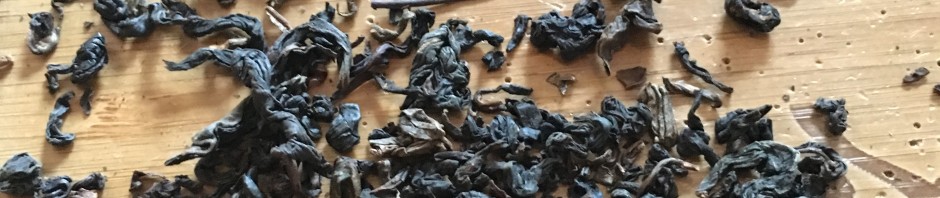
Along with ~50 other people I participated in an aged oolong tasting curated by Marshaln. Marshaln has a fantastic blog, which is easily best English language source on aged oolongs. I highly recommend reading through everything with the aged oolong tag on his site. For the blind tasting I did the full gauntlet twice. Once with Hanji when he passed through Seattle, and a second time with Denny and John on a Dennysode.
Aged Oolongs in the West
Aged oolongs is amongst the least discussed teas types in the online discourse. The best ones Denny and I have come across in the last 10 years from a western vendor are the aged Baozhongs from Everlasting Teas but most of what I drink comes from my travels. The state of the scene has not changed much from its sorry state since I did The Box report about a decade ago.
While I own my fair share of aged oolongs, I don’t talk about them hardly at all. Mostly because I have noone to talk about them with. A tasting like this gives people a chance to drink tea and importantly discuss it and learn together.
The Tasting Design & Distinctiveness
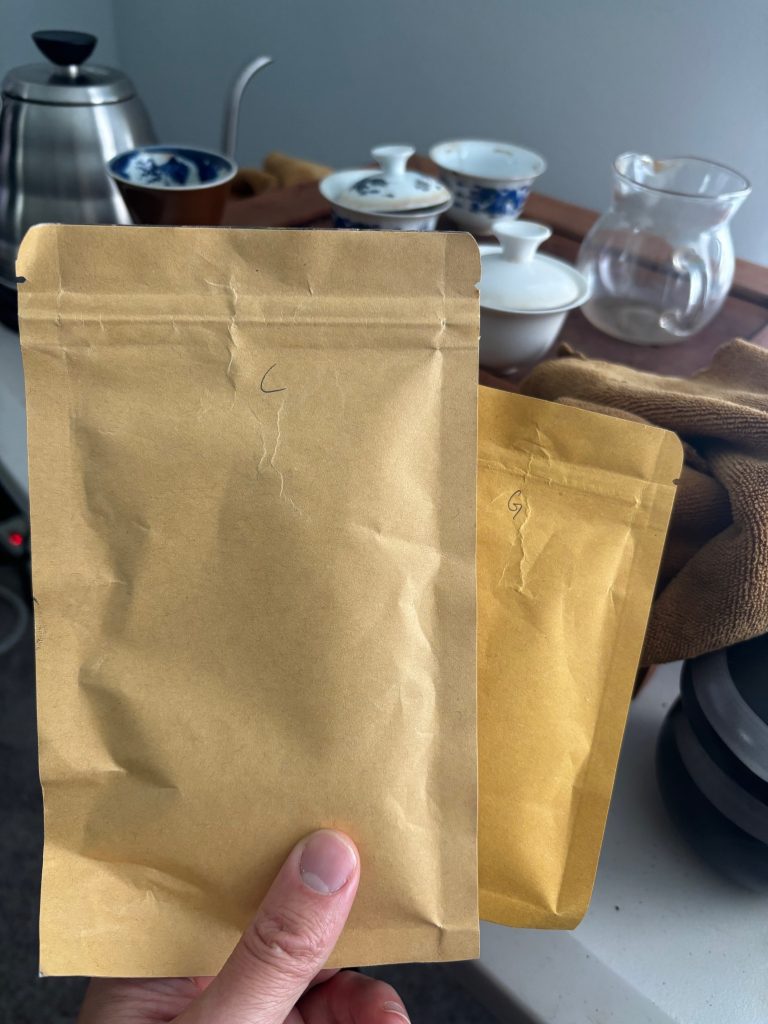
These were labeled A-G and consumed blind.
Even though I have some experience, the tasting was still pretty edifying. Marshaln clearly selected the teas by their distinctive characteristics you’d run into searching for aged oolongs in Taiwan. There’s some overlap between a couple teas but not a lot. The tasting is also instructive because now a set of drinkers have the shared experience of tasting the same set of teas that we can use as references. For instance I can tell Denny it reminds me of tea B in Marshaln’s set and he will know what I mean.
I am writing this up because I am hoping that it can help mentally categorize different sorts of aged oolongs even if you can’t try the teas.
What Were The Teas?
We were instructed to drink A and B first to calibrate our tastes before moving onto C-G. It was also suggested that we drink them all gongfu and grandpa at least once.
A – Presents pretty young and does not have a ton of aged notes. The important thing with A is the semi-aged profile that will develop eventually towards plum. Unlike pu’erh where we can try teas semi-aged or in progress, most of my oolong experience is unaged or aged (25+), which creates a gap in my knowledge of what an oolong in the process of aging should taste like.
Marshaln described this as a 10-15 year old high mountain oolong. Also mentioned that this was recently re-roasted, which was done subtly enough that I did not pick up on. To me this felt closer to young tea than the aged oolongs I’m familiar with.
B- Very roasty and carbonized. B is hard to identify any actual age because it lacks much aged taste. It also represents a type that littered the western scene when I started drinking tea. Very important to be able to identify if you are interested in aged oolongs. The good thing is most are pretty easy to place because the roast is so prominent. Tea that undergoes this sort of heavy re-roasting has its aged notes significantly reduced.
Marshaln described the roast as doing the heavy lifting. He also noted that it brews more brown than red, something that can signify a more roast heavy aged oolong.
C – The first one that really presents a significant amount of aged taste. Has a nice brightness. Wood, leather, some light earth. This is the sort of tea that would easily pass the speed test for me. It is smooth, sweet and easy going down and brews flexibly.
Marshaln described this as a Baozhong with 20+ years of aging. The most interesting part of this is the hint at what it was like when young. Here it is described as having relatively minimal roasting.
D – When Hanji and I originally had this we pegged it as similar to B. This turned out to not line up with later sessions with it. Maybe we were going too fast or the contrast with C was too extreme. It does present very differently than something like C and F. It is earthy, mineraly, the roast is fairly far in background and in the later steeps I could barely taste it. Denny described this as brandy-like. Some nice mouth coating sweetness. Can get a little sour when pushed but nothing too bad. This one seemed to vary quite a bit depending on water and how it was brewed.
According to Marshaln this has unknown provenance and speculated that it might be a heavily roasted export grade tea. The heavy roast and different starting point might explain why D differs from something like C or F which have more minimal roasting.
E – Very musty. A clear through-line to Liubao or ripe pu’erh. Along with B, this would be my least favorite of the set. I’ve ran into a few like this and it’s a type I’d probably avoid. Their smooth and easy going down but I’d rather just drink heicha or ripe over something like this.
The interesting part is how something ends up like this rather than properly aged or even sour (the typical result of getting too much humidity). Marshaln offers some hints saying that the owner discovered that this had turned moldy and ended up storing it with some ripe. He also noted the dullness of the leaves.
F – An immediately appealing tea. Lots of sweetness. Honey, plum, a light tartness when pushed. Decent body. On average I probably had the best time with this tea. Hanji and I guessed this was an old Dongding.
This turned out to be an aged Baozhong. It is older and has developed deeper aged notes than C. I am curious if C would develop more of a similar profile given enough time. Similar to C it is described as having a relatively light roast.
G – Very ground up material. A lot of people have this marked as their favorite. While I agree this has the best material, I had mixed results especially in a mug where I am admittedly a novice. When I got it right, it was very smooth, aged taste, earthy, mineraly. It actually reminded me the most of D, although the material here is better but more ground up.
Marshaln said this is from fannings of old Dongdings from the 1980s, noting the material is the best of the tasting.
Things I Learned
- Minimal roasting even early on is fine. One preconception I had was that only mid-fired or darker teas could be aged. Marshaln speculated that C and F were both light roasted, and those turn out to be two of my favorite profiles. A also had a lighter roasted profile and seemed to be moving in an agreeable and possibly similar direction.
- Learning about aged profiles.. Distinguishing between the aged profile of C and F versus D and G is interesting because it might determine what profile a tea will age into. It’s also interesting to hear how something like A may move into a C or F profile as it gets another couple decades.
- Water matters a lot. This is obvious but there were interesting tasting variations by some of the participants, many of which might be chalked up to the water. In Seattle and the Pacific Northwest people always say we have good water. This might be true, but we more specifically have soft, low TDS water. When I’ve measured the TDS of our tap it is around 30-40TDS, quite different from the majority of other people’s taps.
- Mugging covering up flaws was stressed throughout the tasting. As someone who doesn’t mug tea, it was good to get a bit more experience.
Open Questions: The Importance of Temperature!?
The largest open question I have is on the importance of temperature to the aging. In theory the enemy of aging oolongs is the humidity, making the west a theoretically reasonable place to store them. How important is it to be hot? For pu’erh we know that temperature has a massive impact on the end product and a place that is cold but humid isn’t really very good for transforming pu’erh. For oolongs we simply don’t know.
Thanks to Marshaln for putting this on. I enjoyed drinking and discussing the teas with others!
Leave a Reply