
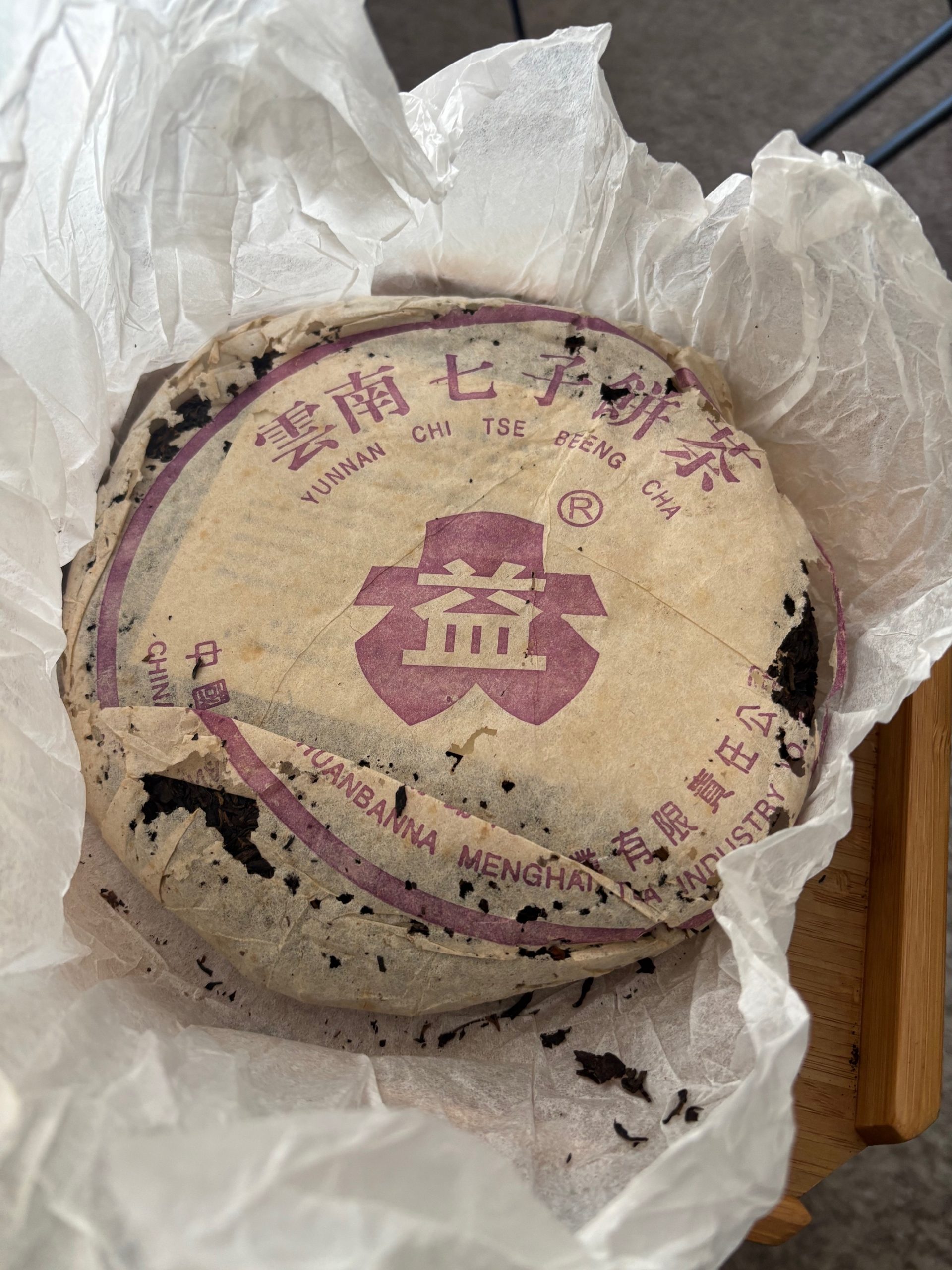
I think if you surveyed tea heads about the most important pu’erh operation over the course of the past century, you’d end up with one answer, Menghai Tea Factory. Not only was Dayi prominently involved in the invention of shu pu’erh cha (ripe tea) but they remain the industry standard for ripe pu’erh production and the primary pu’erh investment commodity for speculators. With falling prices and increasing accessibility, for actual tea drinkers Dayi remains a strong option for both newcomers and veteran drinkers. As I’ve gotten more than a decade into pu’erh drinking, I’ve become more and more convinced that people should start with and get their feet under them with Dayi pu’erh before moving onto other avenues.
Where is Menghai Tea Factory Material From?
Menghai tea factory is based in Menghai county. Like eastern Xishuangbanna (6FM/greater Yiwu) it has a long history of pu’erh production. Unlike that area, Menghai county is generally more associated with larger factories and blending. Menghai Tea Factory has large gardens in varying places around Menghai county and draws primarily from them to make their blends. Mountains like Bada, Bulang, Nannuo, Mengsong, etc. Occasionally you will see teas being marketed from a single mountain like Bulang, but the vast majority of Dayi products are multi-mountain blends.
Why Buy Dayi Teas?
Semi-aged and aged raw Dayi give a solid baseline for pu’erh. It won’t end up as everyone’s ideal but it is definitely one to benchmark. Dayi of a certain age is on average is better than competing factories, Xiaguan, Haiwan, etc. And frankly speaking, boutique teas are weird, variable and much more difficult to benchmark. They offer a huge variety but bring forth many challenging, beginner unfriendly topics. Better to get your feet under you with proper decent factory pu’erh.
Dayi is also now easy to find semi-aged from the late 2000s (2006-2009) and the prices tend towards the reasonable (2008 8582 can be found for $50ish). When I started drinking pu’erh teas in this age range these same teas were not even 10 years old. Now they are nearly 20! I wish I focused more on Dayi and less on boutique, especially when I started. Don’t invest completely into boutique marketing, whether it is a western vendor or a Taiwanese boutique. At least give semi-aged Dayi a proper shot.
For ripe teas this is a no brainer. Dayi has long been considered the standard bearer. While I do like boutique ripes, I’d recommend people try out Dayi first to get their bearings. These are also not expensive. You can easily find under $20-30 357 gram cakes of ripe with a few years. Even their fancy products are usually just a bit more.
Common Mistakes
Menghai Tea Factory vs. Menghai County. I have consistently seen this mistake for over a decade. Menghai County is a very large geographical location where pu’erh is grown. Menghai tea factory / Dayi is a tea factory. Do not assume because something is labeled Menghai it is a Menghai Tea Factory production. Pay attention if it is explicitly Menghai Tea Factory or Dayi.
7542 & 8582. Commission vs. actual production. Oooh I’ve tried a 7542 before, a 2003 7542 before. 7542 and 8582 are Dayi recipes so surely anything under those recipe numbers must be made by Menghai Tea Factory. Wrong. The terms 7542 and 8582 were poorly regulated before 2005, which meant random custom productions not even made by Menghai Tea Factory were circulated as these classic recipes. Beware products that are just generically labeled 7542 and 8582, especially if it does not specify it was made by Menghai Tea Factory. If you want to taste what Menghai Tea Factory tastes like, these are not good reference points and will only lead to even more confusion. Pay attention to whether the recipe is explicitly an official Dayi production. One such example is the 2003 Hong Kong Henry Serious Formula 7542. This is not a Dayi product and does not taste like a Dayi 7542 despite being sold for years as 7542.
Fakes. Dayi is a commonly faked brand and I’ve heard a few reliable people say there’s way more fake Dayi than actual Dayi. Something I have not verified but seems completely plausible. What’s the best way to avoid this? Especially as a beginner it’s simply to follow the path others have traveled. Do not buy the cheapest thing you see on Taobao, use others recommendations to buy from generally reliable sources.

Modern Eras of Menghai Tea Factory
1940-1995 – While Menghai Tea Factory was created in 1940, and there is plenty of interesting history for pre-1996 Menghai Tea Factory, these teas are frankly very hard to find so this information is mostly not too useful. Generally speaking, most of these were pressed under recipe numbers 7542, 7532, 8582, and before that in the 1950s/1960s as Hongyin (Red Mark) and Lanyin (Blue Mark). Teas from this era were almost all traditionally stored (the norm for decades).
1996-2004 – Pu’erh production was privatized and you start to see teas being openly labeled coming from a specific tea factory, i.e. Menghai Tea Factory, Yichanghao, Xiaguan, Haiwan, etc. There’s quite a few products during this time. Various 7542s (1997 Blue Water Mark, 2001 Simplified Yun), the Bok Choy series (Banzhang), Big Green Tree Series, Gold/Silver Dayi, etc. Teas in this period are quite pricy compared to newer eras mainly because production quantity was still not too high yet. The default storage starts to change towards the drier, but a large amount of tea from this period was still traditionally stored, particularly from the 1990s.
2005-2013 – Big organizational change for Menghai Tea Factory. 2005 is an interesting and unique year because it was the first year after the organizational shift. The prices are a fair bit higher than later years but not as high as pre-reform years. One reason occasionally given is that farmers wanted to show support for Menghai TF and provided quality material as a result. I’ve also heard that they still had maocha from pre-reform that had yet to be pressed. During this period a good deal of Menghai TF alumni would go off and start or work at newer companies. This time period was a huge period of growth for the pu’erh industry with increasingly more pu’erh being produced both in general but also by Dayi.
2014-onwards – Not as hard of a cutoff as 2004 was, but this era of Dayi has been marked with a lot of questions regarding their quality, specifically processing changes done to make the tea more palatable quicker, specifically more oxidation and less rolling.
What Teas Should I Try?
As a beginner the sweet spot is the 2005-2013 range. The prices aren’t as crazy as pre-2004 teas and are much easier to find. As you move deeper into the 2010s, there are increasing questions regarding quality and processing. The more age the better in most cases. Although you can certainly try younger Dayi curious, I would try to make earlier teas your goal.
If you have the experience and budget, the earlier era pre 2004 is well worth checking out, just be aware that storage can be highly variable and they will be much pricier than teas post 2004 and harder to find. Also please do remember that just because something carries a Dayi factory recipe label (7542, 8582) it doesn’t mean it’s a Dayi tea. There are a ton of sketchy non Dayi tea floating around with those labels. Try them if you like but do not treat them like a genuine reference of that recipe.
Unlike Xiaguan or most other factories, most baseline Dayi teas from 2005-2010 are typically serviceable. You could pick semi-randomly if you buy in the right range and probably do generally OK. Still, it is always a good idea to get a baseline with their most famous recipes. Try 7542, 8582, and if you feel like it 7532 and Spring of Menghai. For ripe, try 7572, 8592, 7262, and a tip heavy blend like Golden Needle White Lotus. These are not the premium products (those tend to be special productions) but their classic recipes they press frequently.
Where Can I Buy Them?
Taobao remains an underrated source for getting Dayi. Buy from an authorized dealer in the correct age range and you should do alright. One problem I’ve ran into, is the storage often runs a bit drier than my own preference even from the Guangdong sources (climate controlled or shipped from elsewhere). King Tea Mall or Yunnan Sourcing are also around, just expect to pay a bit more with less selection.
With the current trade situation, Taiwan may or may not be an option. Teas We Like and Quiche (TSH) are decent options. Like mainland sources, there’s no guarantee how long they’ve had the tea. Even with all these question marks I think pursuing and trying to develop some understanding of Dayi is something every aspiring pu-head should do.